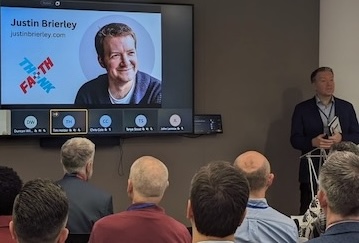
Christianity and the search for meaning are finding their way back into public conversation, and broadcaster and author Justin Brierley believes the Christian story can make sense of some of life’s biggest questions about human existence, value and purpose.
Speaking at CBC Revive 2026 in London, Justin drew on more than 20 years of conversations with Christians, atheists and sceptics to describe a significant change in the public conversation about God. The confident New Atheism of the early 2000s has faded, he argued, while questions about the Bible, Christianity and the meaning of life are finding their way back into mainstream culture.
For those working in Christian media, Justin believes that creates an opportunity. His challenge was not simply to celebrate signs of renewed interest in faith, but to understand why people may be searching in the first place and to tell the Christian story with confidence, creativity and grace.
Justin’s keynote formed part of a much wider conversation at Revive about signs of a new openness towards God and what that could mean for Christian broadcasters and creators. In our conference overview, The tide is turning, people are open to God and the UK Christian media must maximise the opportunity, we explore the challenge that ran through the day: how can Christian media respond to this moment with confidence, creativity and a clear Gospel message?
Christianity and the search for meaning
Justin began by looking back at the cultural landscape in which he started broadcasting. Through Premier Christian Radio’s Unbelievable?, he spent years bringing leading Christians and non-Christians together to debate faith. In the mid 2000s, those conversations took place against the rise of New Atheism and figures including Richard Dawkins, Christopher Hitchens, Sam Harris and Daniel Dennett.
The prevailing argument was that religion belonged to the past and that science and reason would increasingly take its place. Christianity was not simply being questioned. Justin recalled an atmosphere in which Christian faith could readily be dismissed or ridiculed in the public square.
Over the years, however, he began to notice a different kind of conversation emerging. One example came through Canadian psychologist Jordan Peterson, whom Justin hosted in 2018 for a discussion with atheist psychologist Susan Blackmore about whether God is needed to make sense of life.
Justin did not describe Peterson as a Christian, but was struck by the seriousness with which he discussed God, the Bible and the foundations of Western culture. Huge audiences, including many young people, were prepared to listen to hours of lectures on Genesis.
For Justin, that suggested something important had changed. A generation growing up in an increasingly secular culture was still asking questions about meaning, identity and purpose, and some were looking towards the Bible for answers.
“We are made to live within a story,” he told Revive.
Existence, value and purpose
Justin structured much of his keynote around three areas where he believes the Christian story speaks powerfully into that search: human existence, human value and human purpose.
On existence, he reflected on conversations with scientists including Paul Davies, who is not a Christian but has questioned whether the universe can adequately be understood as a meaningless series of accidents. Justin connected those questions about order, comprehension and purpose with the Biblical idea of the Logos, the Word through whom all things were made.
He then turned to human value, drawing particularly on the work of historian Tom Holland. Studying the ancient Greek and Roman worlds led Holland to question where modern Western assumptions about equality, compassion and human dignity had actually come from. Justin described how Holland came to recognise the profound influence of Christianity and Jesus Christ on values that modern Western societies can easily assume are simply universal.
That leaves an uncomfortable question for an increasingly post-Christian culture. Can we continue enjoying the fruit indefinitely after cutting ourselves off from the roots?
Justin’s third theme, human purpose, brought his argument most directly into the world in which Christian communicators are working today. Science can tell us extraordinary things about the physical universe, technology can transform our lives and politics can shape society, but Justin argued that none of them can ultimately tell an individual why his or her life matters.
What happens when we lose our story?
Justin believes Western culture has spent generations dismantling the Christian story without necessarily finding another story capable of replacing it. People do not stop searching for meaning simply because Christianity retreats from public life. Instead, they look elsewhere for stories through which they can understand who they are and what they are here for.
He suggested that some of the fierce political and cultural battles of recent years can be understood partly through that search. Political identities and competing ideas about the self can begin carrying a weight they were never designed to bear, while social media intensifies the problem by placing competing worldviews against one another in an environment which often rewards outrage and division.
Justin described this as part of a wider “meaning crisis”, but believes that crisis may also create an opening for the Gospel.
“We cannot save ourselves through technology or science or politics,” he said. “We need a better story than all of those.”
For Christians, that better story is not an abstract philosophy. The Bible begins with God creating human beings in His image, giving every person profound worth and dignity. It takes seriously the brokenness of the world and the reality of sin, but God does not abandon His creation. He enters it in Jesus Christ and, through His death and resurrection, offers forgiveness, restoration and hope.
That is a very different message from telling people simply to find their own meaning. It says our lives have meaning because they belong within a much greater story, one that begins with God and ultimately finds its hope in Him.
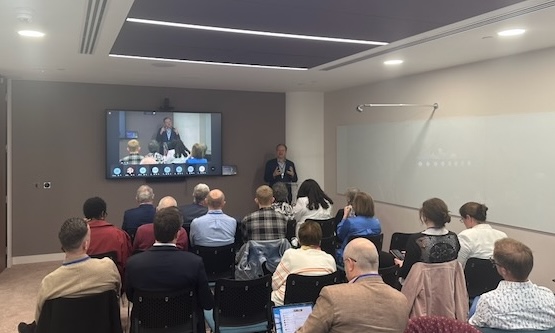

Justin Brierley at CBC Revive 2026 where he spoke about Christianity, the search for meaning and the opportunity facing Christian media.
When atheists start asking different questions
Justin illustrated the cultural change through several people he has encountered during his years of broadcasting. Douglas Murray has described himself as a “Christian atheist”, recognising the Christian inheritance behind many of his beliefs about humanity and Western civilisation despite not professing Christian faith. Tom Holland has spoken about discovering how deeply Christian ideas have shaped his worldview, while Jordan Peterson has introduced enormous audiences to serious discussions about the Bible and God.
These are not straightforward stories of Christian conversion, and Justin did not present them as such. What they demonstrate, in his view, is that Christianity is being discussed differently in parts of the public square. Questions which appeared to have been dismissed during the height of New Atheism are being opened again.
Then there are those who have crossed the line into faith. Justin highlighted Ayaan Hirsi Ali, once one of the world’s best-known atheist voices, who publicly announced in 2023 that she had become a Christian.
Justin described a journey that went beyond intellectual arguments about Western civilisation. Hirsi Ali had also been wrestling personally with meaning and purpose, and he recounted how a counsellor encouraged her to consider prayer. As she thought about the kind of God to whom she might be able to pray, she found herself describing Jesus Christ.
“Maybe I do not need to invent a new God,” Justin recalled her concluding. “Maybe I can begin with Jesus Christ.”
For Justin, her story is a reminder not to assume anyone is beyond the reach of God. “If it can happen to Ayaan Hirsi Ali, one of the most famous atheists in the world, it could happen to anyone.”
Openness without exaggeration
Towards the end of his keynote, Justin turned from the intellectual conversation to signs that attitudes towards faith may also be changing more widely, particularly among some younger people. He pointed to reports from churches and Christian organisations, growing interest in the Bible and developments in parts of Europe which he believes deserve attention.
Importantly, however, he also addressed the withdrawal of the Bible Society’s Quiet Revival report after methodological problems were identified with its survey data. Rather than ignoring that development, Justin cautioned against jumping to either extreme. The withdrawal of one report does not prove revival is happening, but neither does it prove that nothing is changing.
That distinction is particularly important for Christian journalists and broadcasters. We do not need to exaggerate what God is doing or make statistics carry more weight than the evidence allows. Christian media should be willing to test claims, acknowledge uncertainty and correct the record when evidence changes. Confidence in the Gospel does not depend on every encouraging statistic being proof of revival.
At the same time, healthy caution should not prevent Christian communicators from noticing genuine changes in the questions people are asking. Justin’s argument was not that a national revival has been statistically established, but that after years in which Christianity often appeared to be disappearing from public conversation, there are signs of renewed curiosity worth taking seriously.
A story bigger than politics
Justin also warned that renewed interest in Christianity can become entangled with political movements. He spoke about the rise of so-called Christian nationalism and his concern that political actors can seek to co-opt interest in Christian identity for their own purposes.
“We have to have a message that speaks to the left and the right,” he said.
For Christian media, that challenge matters. Broadcasters, journalists and creators operate in a communications environment where outrage travels quickly, algorithms can reward division and political identity can easily become confused with Christian faith. Justin’s warning was that the message of Christianity must not be allowed to become subordinate to a political message, whichever direction it comes from.
Instead, he called Christians to communicate with confidence, creativity and grace. In a culture accustomed to cancellation, hostility and polarisation, Christian communicators have an opportunity not only to tell a different story but to demonstrate a different way of speaking to people with whom we disagree.
Christian media has a story worth telling
That brought Justin’s keynote directly back to the broadcasters, journalists, podcasters, musicians and digital creators gathered at Revive. Every programme, interview, article, song, podcast and video has the potential to enter somebody’s life at a moment when they are asking questions.
Justin believes more people may now be asking those questions.
“People are looking again for a better story of reality,” he said, “and we have the greatest story ever told.”
His challenge was to tell it. “Now’s the time for us to tell it. Tell it with confidence, tell it with creativity.”
That does not mean manufacturing revival or chasing every apparent cultural trend. It means understanding the people we are trying to reach and recognising that behind debates about culture, identity, technology and politics are human beings still asking some of the oldest questions of all. Who am I? Why am I here? Does my life have meaning? Is there hope?
Christian media has something more substantial to offer than another opinion competing for attention. We can point people towards Jesus Christ.
Towards the end of his keynote, Justin returned to the picture of broadcasting as scattering seed, an image also explored during Kevin Bennett and Marcus Jones’s Revive session on the history and future of Christian broadcasting. Justin suggested that 20 years ago much of that seed seemed to be falling on stony ground. Today, he believes some of the soil may be changing.
“I think this is a unique missional moment,” he said. “People are ready to hear again.”
Whether or not history eventually calls this period a revival, that is a challenge worth hearing. Christian communicators are still called to sow the seed faithfully, tell the story well and trust God with where it lands.
Watch Justin Brierley’s full keynote address from CBC Revive 2026 above. Justin also joined Professor John Lennox at Revive for a conversation about communicating truth in an age of AI, deepfakes and growing scepticism, exploring another part of the same challenge facing Christian communicators in a rapidly changing media landscape. See Communicating Truth in an Age of AI and Deception.
You can discover more of Justin’s work through Think Faith and Justin Brierley, including The Surprising Rebirth of Belief in God podcast and his books The Surprising Rebirth of Belief in God and Why I’m Still a Christian. Justin also has several listings in the CBC UK Directory. This exists to help Christians discover the broadcasters, programmes, podcasts, YouTube channels, ministries and media professionals sharing the Gospel across the UK. If you are involved in Christian media, you can submit a free listing and help more people discover your ministry, network, programme or series.