Announcing the CBC Journalism Training Course
The Christian Broadcasting Council is pleased to announce the launch of its new Journalism Training Course — a dedicated programme designed to equip working journalists and aspiring reporters with the religious literacy they need to cover the world accurately.
Religion is back at the centre of global affairs. From the conflicts of the Middle East to the relationship between Donald Trump and the Pope, from the Church’s role in the cost-of-living crisis to the rise of AI and its intersection with faith — the stories dominating our news cycle cannot be fully understood without a grounding in religion.
Yet the majority of today’s journalists have received little or no training in this area. Our new course for journalists aims to change that.
The gap that’s costing journalists the story
Ask any young journalist whether their training covered religion and the answer is almost always the same: it didn’t. Journalism courses have simply stopped teaching it — assuming, perhaps, that faith was in decline and the subject irrelevant.
They were wrong.
Today, with 2.8 billion Christians worldwide, with Islam shaping geopolitics and with faith communities on the front line of everything from food banks to community tragedy, religious illiteracy isn’t just a gap in knowledge. It’s a barrier to good journalism.
In our pilot video, young journalists speak candidly about what it’s like to navigate this gap in their professional lives — and why a course for journalists that takes religion seriously is long overdue.
What the course will cover
The CBC Journalism Training Course is being built around a simple premise: if you don’t understand faith, you’re missing the story. The programme brings together experienced broadcasters, media leaders and Christian communicators to give journalists the tools they need to:
- Understand the world’s major religions and their denominations
- Identify the religious angle in mainstream news stories
- Report on faith with accuracy, balance and confidence
- Build trust with faith communities as credible sources
- Navigate the sensitivities of religious reporting without avoidance
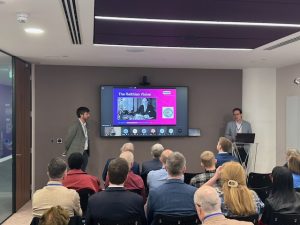
The course is being introduced at CBC Revive 2026, our first annual conference for Christian communicators and will be presented by veteran broadcaster Roger Bolton and Rev Jonathan Ford, Conference Director.
Why this natters now
One of the journalists in our launch video puts it simply: “Every mainstream story has a religious angle, even if it doesn’t seem apparent at first.”
Cost of living? Churches are running food banks. Crime in communities? Faith leaders are often the first call. The Trump-Pope dispute? Impossible to report accurately without understanding the distinction between Catholicism and Protestantism. The rise of AI? Already intersecting with questions of truth, identity and belief.
And yet journalists routinely avoid these angles, not out of hostility, but out of fear. Fear of getting it wrong. Fear of causing offence. Fear that they simply don’t know enough.
This course for journalists is designed to remove that fear and replace it with confidence.
Full Transcript
The following is the full transcript of the CBC Journalism Course pilot video.
Roger Bolton: Right now, religion in general, and Christianity in particular, is centre stage in world affairs. Arguably, it has always been so. Until recently, the Christian faith in particular has been treated as if it was in terminal decline or something to be avoided. As Alastair Campbell, Tony Blair’s press chief, put it: “We don’t do religion.” Not now. There are more Christians around the world than there have ever been.
British history, of course, has Christianity at its centre, and almost all of our institutions, as well as our society’s assumptions about the behaviour of its citizens, have been profoundly influenced by Christianity. And the wider world — the unending troubles of the Middle East cannot be fully understood without an awareness of the historic rivalries between Jews, the different branches of Islam (Sunni and Shia) and Christianity (Roman Catholic, Orthodox and Protestant).
Yet how much of this is widely known at a time when religious literacy is essential to understand the modern world and report on it accurately? We find that the new generation of journalists is unprepared for these events. Its members have inherited little or no knowledge of the world’s religions, let alone of their different denominations. Religion as a subject is not included in the courses they follow to obtain their qualifications.
CBC, like many others, is very concerned about this issue and asked a selection of young journalists about their experiences of trying to understand and respond to the present issues we face, yet referencing them from a standpoint of informed religion.
Anna Rees Green, Multimedia journalist: As a journalist, being religiously literate is really important because the job is fundamentally about understanding people and understanding societies. And religion, even if you are or aren’t religious, makes up such a huge part of the picture of life here in the UK. To understand the fundamentals of that, and to be able to see eye to eye with somebody you may not completely agree with, is going to give you a really good grounding at getting alongside people and getting alongside social issues.
Jamie Pratt, Radio producer: I think, at least when I was at university, there was a school of thought that this was slowly going out the window. We’d just had the peak and decline of the new atheists — that rationality was the way forward, that secularism was the way forward. But I think in the world today, we’re seeing what that looks like without that.
Jamie Lewis, Multimedia journalist: It’s not one of the specialisms that we look at. You might think you have the big ones like politics, lifestyle or sport — but religion didn’t really ever seem to come into that. I don’t know whether that’s because the tutors didn’t think they had the right skills or knowledge, or if they just didn’t think it was interesting or worthwhile talking about. But there’s a huge gap there.
Jamie Pratt, Radio producer: The people in charge of the syllabuses thought, “We’re not going to need this in 10 or 15 years.” But as we’re seeing in the world around us, religion is even more prevalent than it has been before.
Tola Mbakwe, News editor: When it comes to politics, education, crime, sexuality — religion plays a part in so many different topics. And if you don’t really know about that, things can be missed. For example, due to the cost of living, there’ve been stories about lead theft from churches, heating oil stolen from church premises. Journalists will cover cost of living — rising food banks, how it’s impacting people — but actually, how is it impacting places of worship?
Jamie Lewis, Multimedia journalist: You can often get to the heart of the story from a religious angle. If something’s happened in a community — maybe a tragic incident — there’ll be a faith leader, a priest, a vicar, an imam, someone from the faith community who will be able to really speak for that community.
Anna Rees Green, Multimedia journalist: Every mainstream story has a religious angle, even if it doesn’t seem apparent at first. When it comes to cost of living or political crises here in the UK, churches and other religious organisations are often on the front line — opening doors for food banks, charity projects. They have the face-to-face links with people who are actually living out the effects of the political headlines that we see and report on. So being able to get alongside a church or a mosque or any kind of religious community will really give you an inroad to understanding what the human face of those issues looks like.
Nayana Mena, Multimedia journalist: It’s around 2.8 billion people worldwide who are Christians. That’s quite a big figure. If we didn’t know anything about the faith, how could we accurately report on those stories — and target some of our stories to appeal to those people? It’s really important so we can report ethically and impartially, to have a good understanding and to build that trust with our audiences.
Anna Rees Green, Multimedia journalist: The dispute between Trump and the Pope is a perfect example of religious literacy being so important in journalism. It’s so easy to stereotype either side and to not fully understand the significance of the Pope’s actions. It’s probably quite easy to think that Donald Trump speaks for one kind of Christian and to ignore the complexities of Catholicism and Protestantism, and how that interweaves into this new frontier of social media and how Donald Trump is using AI to connect with his voter base. If you understand religion, you’ve got your eyes open, and you’re so much better placed in our AI era to see what is smoke and mirrors from what is a genuine message.
Can you sell religious stories to mainstream newsrooms?
Nayana Mena, Multimedia journalist: Journalists in mainstream organisations are scared of covering religion — because of sensitivities, and maybe scared because they feel they don’t know enough. But then also scared of the backlash they may receive from other faiths or people of no faith at all. They’d rather stay clear of it completely than report those interesting stories that there is an appetite for.
Jamie Pratt, Radio producer: What we’ve just been establishing, really, is that this is a crucial part of how the world turns. If you get that across to them, they will know that: I need to know this. I need to know these texts. I need to know these are the people we go to in a time of crisis. We need to know about these religions and why they operate the way they do. If you get that across to them, then it will be impossible for them to leave that out of their journalism.
Ready to build your religious literacy?
The CBC Journalism Training Course is open to working journalists, journalism students and Christian communicators who want to report on faith with confidence and accuracy. email jonathanford@cbc.org.uk if you would like to participate in this project.